Sentiment slips in September on economic risks and rising living costs
Posted on: 29 Sep 2026
-
Signs of cooling in jobs market and spate of cost increases weigh on consumer mood
-
Contained fall in sentiment suggests that while Irish consumers are nervous, they are not dramatically more negative
-
Contrast between improving UK consumer confidence and sliding sentiment elsewhere hints at importance of 'policy optimism' in consumer thinking
-
Special survey questions focus on Irish consumers’ top 3 priorities for Budget ‘27
-
44% want improvements in healthcare while 41% want help with living costs
-
38% of consumers want measures to ease housing shortfall
-
29% want an easing in the tax burden on workers
-
13% prioritise measures to maintain the sustainability of the public finances
-
11% prioritise the introduction of a special savings scheme
- Only one in twelve see Budget ’27 significantly improving their living standards while one in two expect no improvement
Speaking on the release of the September sentiment survey, David Malone, CEO of the Irish League of Credit Unions noted ‘The drop in consumer sentiment in September is not at all surprising, with worrisome increases in global energy prices of late emphasising the strains many Irish households will face in keeping their homes bright and warm through the winter months ahead. For assistance in budgeting, and with all their financial needs, it is important that consumers know they can rely on their local credit union.’
Summary
Irish consumer sentiment fell marginally in September more than reversing the slight increase seen in August and leaving the economic and financial mood of Irish consumers at a four-month low.
The September survey period saw a wide range of developments that served to confirm a picture of downside risks to the economy and upside risks to living costs.
World oil prices rose sharply while there were further announcements from domestic suppliers of increases to household energy bills as well as bus and rail fares. Warnings about the underlying health of Ireland’s public finances also conveyed a picture of a more threatening future.
There were more signs of cooler conditions in the Irish jobs market while higher interest rates and additional increases in health insurance emphasised a seemingly relentless pressure on household finances.
While the economic and financial news-flow through the September survey likely weighed materially on the mood of Irish consumers, most elements had a fairly familiar if worrisome ring. As a result, the fall in sentiment from an already subdued level was limited.
More significant moves in Irish consumer confidence may depend on movements in global energy costs and the capacity of Budget ’27 to ease ongoing pressure on household finances.
Section I; September survey suggests Irish consumers seeing familiar reasons to be fearful
As the table below indicates, the Credit Union Consumer Sentiment Survey (in partnership with Core Research) shows a modest fall to 61.1 from 63.2 in August. This was sufficient to bring sentiment back to its lowest level since May 2026.
The past four months have seen choppy but modest movements in Irish consumer sentiment as prospects for an end to war in the Middle East seemed to repeatedly change.
The relatively limited scale of movement in the survey through recent months coupled with fairly subdued sentiment suggests that Irish consumers don’t see circumstances in which the economic and financial damage caused by the conflict can quickly be repaired.
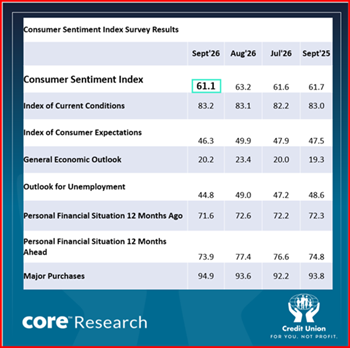
The nervous mood of Irish consumers at present is reflected in the distance that September 2026 sentiment survey reading of 61.1 lies below the long-term survey average of 83.0 or the most recent ten-year average of 76.1.
The limited monthly fall in sentiment in September brings the index back in line with its twelve-month average of 60.8. This highlights that a combination of economic uncertainty and financial pressure have been key features of the circumstances of Irish consumers through most of the past year.
US And Euro Area consumers gloomier again in September, UK consumers’ confidence swing continues.
While the mood of Irish consumers weakened marginally in September, US consumer sentiment saw a further material decline to its lowest level since May and also its second lowest reading in more than five decades.
The authors of the US report noted that expectations for household finances and business conditions ‘plunged’ in September as motor fuel prices rose materially and trade tensions with Canada intensified. Some sense of US consumers’ concerns around rising living costs is reflected in a jump in one year inflation expectations to 4.6% from 4.0% in August.
Euro Area consumers were also gloomier in September, with confidence weakening after four months of recovery. Sharp increases in motor fuels of late as well as the threat of higher inflation to come, that was reflected in the European Central Bank’s decision to raise rates in early September, likely weighed on sentiment.
In marked contrast, UK consumer confidence posted its third successive monthly rise in September, the first time this has happened in more than two years. The increase was broadly based but primarily driven by improvements in thinking about recent developments in the economy and household finances.
While recent UK economic data have surprised somewhat to the upside and inflation may have been slightly lower than feared, we think that recent sentiment gains in the UK owe much to a continuing ‘Burnham bounce’ on expectations of a shift in the stance of domestic policymaking in a more consumer-focussed direction.
There may be a sense that it is better to travel hopefully in terms of policy expectations in the UK survey. The fact that buying conditions saw the sole monthly weakening in the September UK confidence reading suggests British consumers suggests financial strains remain a key issue for many households there. The major question is whether the upcoming Budget in the UK will suggest policy is moving in a more supportive direction.
‘Macro’ risks and rising costs weigh on Irish consumer thinking
Four of the five main elements of the Credit Union Consumer Sentiment Survey (in partnership with Core Research) showed month-on-month declines between August and September.
The largest fall was seen in the ‘macro’ component of the survey whose two elements focus on general economic prospects and the outlook for jobs.
Irish consumers have been consistently negative about the outlook for the Irish economy. Although the September reading is some distance above those seen in the Spring when the war on Iran began, the survey suggests a strong consensus among consumers that the Irish economy will weaken over the next twelve months.
The September survey period saw concerns grow about the global economy as increased hostilities in the Middle East threatened greater disruption to global trade routes and energy supply in particular.
The associated surge in world oil prices (from $91.6 per barrel at the end of the August survey period to $105.80 at the end of the September survey) threatened a further substantial drain on spending power in advanced economies ahead of the onset of increased seasonal spending on heat and light in the Northern hemisphere.
In addition, commentary through the survey period ahead of the upcoming Budget ’27 in early October saw repeated warnings about the sustainability of the current trajectory of Irish Government spending.
Estimates of a significant cost to households from increased Government spending attracted much attention during the early part of the September survey period, even though, as we noted in our commentary on the August survey, those estimates failed to take account of a much larger boost to spending power from that Government spending.
The largest month-on-month decline in sentiment in September was in relation to consumer thinking around the outlook for jobs. Given measurement issues around Irish economic growth numbers, it is likely that sentiment readings on jobs also reflects a broader assessment of domestic economic prospects.
However, the late-August release of labour force data for the second quarter confirmed earlier indications of a notable cooling in jobs growth through 2026, while media reports also highlighted further layoff threats at PayPal and TikTok.
Against these influences, there were also some new job announcements while the unemployment rate remained at 5.0%. As a result, the weakening in sentiment towards jobs in the September survey is probably best seen as a modest ongoing downgrade rather than a marked change in consumer thinking.
Irish consumers more nervous about their household finances in September
The September sentiment survey saw consumers slightly more negative about the manner in which their household finances had developed over the past twelve months and markedly more negative about how they might develop in the next twelve months.
Irish inflation accelerated to 3.7% in August from 3.4% in July, led by a sharp turnaround in oil prices. Upward pressure on borrowing costs was signalled by the ECB announcing another increase in official interest rates in early September and markets anticipating a sequence of rate hikes through the next twelve months.
In addition, several more domestic energy suppliers notified material increases in their pricing while there were also announcements of further increases in health insurance costs.
The survey period also saw the announcement of a 15% average increase in bus and rail fares to take effect from next January. The fact that these were the first increases in this area may have encouraged a view that a new era of larger price increases has now taken hold.
These developments go some way to explaining the weakening in consumer thinking on their household finances in September. A sense of the scale of strains on household finances might be gleaned from the latest Central Bank quarterly bulletin (published after the September survey closed) which estimates that the average Irish household’s inflation-adjusted disposable income will be slightly lower through the three years 2025 to 2027 than it was in 2024.
A similar sense of current difficulties is suggested by the latest energy arrears data which came out during the survey period. These show 14% of domestic electricity customers and 27% of domestic gas customers in arrears in July 2026, with 90-day arrears of 8% and 14% respectively in those two areas.
We should also point out that a sense of substantial variation in Irish consumers’ financial circumstances, repeatedly evidenced in the survey findings, is suggested by the coincidence of widespread signs of financial strain alongside the clamour for tickets for Katie Taylor’s farewell fight in Croke Park as well as the speedy sellout of tickets for next year’s Electric Picnic festival.
Four of the five elements of the sentiment survey declined in September. Against a backdrop of increasing uncertainty and financial pressure, it is somewhat surprising that September saw Irish consumers upgrade their assessment of the current buying climate for the second month in a row.
We should caveat that the September improvement is modest and negative views continue to significantly outweigh positive views in this area.
We might also speculate that it may owe something to spending commitments such as ‘back to school and/or seasonal clothing. We could add that it may be supported by a significant easing in food price inflation of late and, perhaps, by a sense that spending power may not be as strong in the future.
Section II; What do Irish consumers see as the key priorities for Budget ’27?
As usual, the Credit Union Consumer Sentiment Survey (in partnership with Core Research) included a couple of supplementary questions on topics of current interest. As was the case in each of the three previous years, this month’s survey asked Irish consumers what they felt should be the priorities of the upcoming Budget ’27 which will be delivered on October 6th.
As Irish consumers attempt to negotiate their way through a range of economic and financial challenges at present, we felt it may be more instructive to ask them to list a number of areas that they felt should be central to Budget '27 rather than just one.
For this reason, consumers were asked what they felt should be the three main priorities for the Budget package. So, the results shown in the table below show the number of consumers who gave each response as one of their three options. (Consequently, the total of responses sums to 300%).
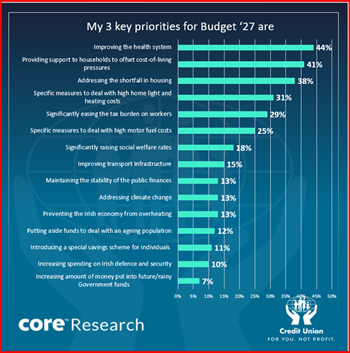
While there has been a slight shift compared to results from previous years, consumer thinking as to what the priorities for Budget’27 should remain very clear cut and consistent.
Healthcare and housing remain priority areas while the importance attached to various means of putting more money in people’s pockets means that protecting living standards is paramount in consumer thinking.
Improvements in healthcare are still seen as a key issue for Budget ’26, with 44% of consumers citing this as a priority. However, this represents a significant drop from the 48% of consumers giving this response last year and a notable change from the 55% of consumers referencing healthcare ahead of Budget ’25.
Although healthcare is still regarded by consumers as the number one priority area, the trend decline in its share of responses may signal some concern around the results achieved given the rapid pace of increase in spending in this area in recent years.
Not surprisingly, those aged over 65 were markedly more focussed on healthcare than others. Females tended to prioritise healthcare notably more than males. There was slightly more focus on healthcare on consumers outside Dublin but there was no clear correlation between income or financial capacity and the priority attached to healthcare.
While housing remains a priority for Budget ’27 according to 38% of Irish consumers, as is the case with healthcare, this represents a somewhat reduced importance compared to responses from previous years (45% of responses in 2025 and 47% in 2024). As with healthcare, it is not clear from the survey responses if this represents increased satisfaction with the current situation or growing concern that increased spending is not leading to the degree of improvement expected in outcomes.
In contrast to the 2025 survey results, housing was prioritised more frequently by those aged under 45. As was the case in 2025, this response tended to increase in emphasis as incomes rose or as difficulty making ends meet reduced. It was also cited slightly more frequently by consumers in Dublin and Munster than elsewhere.
A range of options given in this survey question were intended to assess the importance of policy measures to alleviate pressure on household finances. Some sense of the breadth of strains on household spending power is emphasised by 41% of Irish consumers prioritising cost-of-living supports. This share is effectively unchanged from the 42% seen a year ago and emphasises the persistent nature of difficulties in relation to more expensive living costs.
This issue was more frequently cited by consumers outside Leinster and by females. Not surprisingly, those indicating difficulty making ends meet were nearly 50% more likely to cite this as a priority. Those aged over 65 were notably less likely to cite this as a priority as were those under 25. However, it was mentioned with increasing frequency among age groups from 25 up to 55.
A sense that cost of living issues range far beyond energy might be inferred from the fact that the share of consumers citing specific support measures to tackle domestic light and heating bills at 31% runs some distance behind the priority attached to general cost-of-living supports.
Domestic energy-specific measures tended to be cited comparatively frequently by consumers outside Dublin, by females and by those aged 45 and over. While this response was more common among consumers facing difficulties making ends meet than those without problems in this regard, the gap between these two categories was relatively limited.
This commonality may reflect that pressure from higher household energy charges is broadly based and/or there is a sense that such measures may be a standard policy response to more expensive energy.
Measures to alleviate the increased cost of motor fuels were seen as a priority by some 25% of consumers. This option was more frequently favoured by those outside Dublin, by those aged 25 to 35 and by those facing difficulties making ends meet. It also tended to feature more frequently in responses from lower income consumers.
It is very clear that the Government cannot and shouldn’t attempt to fully offset the impact of higher fuel costs. That said, the September sentiment survey suggests significant numbers of consumers see merit in measures that cushion the blow.
The composition of those prioritising motor fuel supports in the September sentiment survey also argues at least tentatively against the frequently made proposition that motor costs fall more heavily on the comparatively wealthy in Ireland.
It may be worth teasing out this particular response as most mainstream economic commentary has tended to argue against cushioning the impact of higher motor fuel prices on distributional grounds. In this context, it is important to emphasise that seasonal spending patterns mean, at least thus far, the impact on households has primarily been felt through motor fuel rather than heating oil cost increases.
The nature of the Irish labour and housing markets suggest that the burden of significant and non-discretionary roads-based commuting and associated family travel is likely to fall heavily on younger and middle-income workers. Those in the higher income categories are more likely to have shorter and often less car-based commutes as well as more likely to own electric vehicles. At the other end of the income spectrum, households may also rely less heavily on car-based travel.
In that event, motor fuel supports might be considered to be targetted in that they specifically relate to the costs actually incurred. The September survey results might also hint that some element of motor fuel supports in Budget ‘27 may be equitable as well as efficient in that many or most of those assisted by such measures may be finding it difficult to adjust to those extra costs.
Some 29% of consumers indicated that easing the tax burden on workers should be a priority for Budget ’27, a slightly higher share than in previous years.
This response showed pronounced demographic differences in relation to age, with those aged 45 to 54 markedly more likely to see this as a priority than other age groups and a marked fall-off in emphasis among older age groups. Not surprisingly this response tended to be correlated with income but perhaps surprisingly, it was slightly less prominent among responses from Dublin consumers than elsewhere.
Progress on problems and protection of living standards a much greater priority for consumers than fiscal prudence
In spite of overwhelming economic policy advice on the dangers of ‘giveaway’ measures in the Budget and risks related to the sustainability of the public finances, relatively small numbers of consumers feel Budget ’27 should prioritise ‘the stability of the public finances’ (13%). Broadly similar numbers favour ‘putting funds aside to deal with an ageing population’ (12%), or to handle ‘any future shortfall in tax revenues’ (13%) or ‘preventing the economy from overheating (13%)’.
In very broad terms, Irish consumers appear to attach roughly three times the importance to measures to improve health and housing outcomes and measures to ease pressure on current living standards as they do to ‘prudence-focussed’ policy measures.
We wouldn’t interpret these findings as implying that the majority of consumers are blind to the lessons of the financial crash. The focus on improved infrastructure and living costs might suggest that consumers simply view these issues as larger and more immediate threats to economic and financial stability than fiscal constraints may become in the future.
Prudence-focussed responses tended to be given more frequently by male consumers than females, by Dublin-based consumers than those elsewhere and by those aged under 25 than older age groups. That said, those aged over 55 also tended to mention measures to deal with an ageing population more than other groups.
Those with difficulty making ends meet at present tended to place less emphasis on the stability of the public finances and putting more money into rainy day funds than those who say they don’t face financial difficulties at present. However, those with current financial problems tended to attach a higher priority to measures to address an ageing population, perhaps suggesting a sense that their financial strains may not be short-lived.
For the September 2026 survey we also asked consumers whether introducing a personal savings scheme was a priority area for them. Just 11% of consumers cited a personal savings scheme as one of their three Budget priorities.
These responses were slightly more prevalent among consumers based in Dublin, among males than females, and among those aged 25 to 35 than other age groups. Perhaps surprisingly, there was no clear differentiation of responses by income level or current financial capacity.
We also asked if Irish consumers felt increased Government spending on defence and security should be a priority for Budget ’27. Some 10% of consumers included it in their three top priorities, with this response more commonly seen among Dublin-based consumers, among those aged under 35 and among males than among females.
The September 2026 sentiment survey also asked consumers the extent to which they expected measures in Budget ’27 would impact on their living standards in the coming year.
As the diagram below illustrates, consumers expectations for substantial support from Budget ’27 are quite limited. They are marginally higher than a year ago. However, this might be deemed a relatively limited change considering that pre-Budget commentary in recent weeks has emphasised the importance of income tax adjustments and other measures to ease pressure on living costs in marked contrast to a year ago when pre-Budget commentary specifically ruled out income tax adjustments.
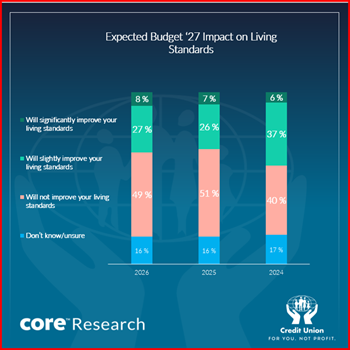
Importantly, in spite of the tone of much media commentary, the diagram below suggests that there no expectation of ( or appetite for?) a ‘Giveaway’ Budget, in the sense of consumers envisage Budget measures delivering a marked boost to their household finances for the year ahead.
The Credit Union Irish Consumer Sentiment Survey is a monthly survey of a nationally representative sample of 1,000 adults. Since May 2019, Core Research have undertaken the survey administration and data collection for the Survey. This tranche of the survey was live between the 2nd and 16th September 2026.