Irish Consumers are Wealthier but more Worried as Sentiment Survey marks 30 years
Posted on: 15 Oct 2026
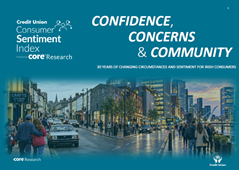 A new report marking 30 years of the Credit Union Consumer Sentiment Index (in partnership with Core Research) finds that while Ireland and its consumers have become substantially wealthier, the prevailing mood among households remains nervous and broadly negative.
The research, which examines consumer sentiment dating back to 1996 alongside other economic indicators, shows that consumer spending in Ireland has increased by approximately 90% over the past 30 years, compared to an EU average of 47%.
In 2026, the average household wealth per person is now more than three times its 1996 level, however sentiment remains weak. The September 2026 Consumer Sentiment Index shows consumer confidence at 61.1, well below the long-term 30-year average of 83.0, and its peak of 130.9 in 2000.
The research reflects the major economic events that have shaped modern Ireland, from the Celtic Tiger years to the financial crash and more recent global shocks. While many acknowledge that Ireland has improved, people are more pessimistic about their day-to-day financial wellbeing.
To mark the anniversary, Core Research conducted new research in September 2026, asking people to reflect on what has become better or worse since 1996 and what they expect life in Ireland to look like in 2056. Some of the recent key research findings include:
- Three quarters (75%) believe the cost of everyday living is worse now than 30 years ago.
- Three quarters (75%) believe the ability to afford or buy a home is worse.
- More than half (54%) believe people’s ability to save money has deteriorated.
- More than half (54%) believe consumers’ financial security is worse.
- More than half (52%) believe mental health and wellbeing has deteriorated.
- Just over half (51%) believe the sense of local community has weakened.
The report suggests that rising wealth has not translated into greater confidence at present. In 1996 consumers in Ireland were experiencing a clear improvement in employment, incomes, migration and inflation following the economic difficulties of the preceding decade. However, in 2026, consumer sentiment is impacted by markedly higher living costs, infrastructure constraints and concerns about Ireland’s exposure to international policy changes against a backdrop of geopolitical instability and persistent economic shocks.
The research also illustrates how an overall increase in wealth in the past decade has not translated into notably stronger spending or a clear ‘feelgood’ factor on the part of Irish consumers in marked contrast to the experience of the ‘Celtic Tiger’ era.
This likely reflects psychological as well as financial scarring in the wake of the crash. Another influence may be marked variations in current circumstances across the spectrum of Irish consumers. The sentiment survey repeatedly highlights signs of a three-tier consumer economy, comprising of the ‘comfortable’ who having savings and can spend, the ‘coping’ who are managing but are spending conscious, and the ‘clinging on’ who are under sustained financial pressure. The differing experiences of these groups will impact the future of Ireland’s economic and social priorities.
Looking to the next 30 years, consumers are cautiously optimistic about some aspects of Ireland's future. Almost half (48%) expect Ireland’s understanding of environmental issues to improve further, while a similar proportion (45%) expect better education opportunities. Expectations for overall quality of life are also somewhat more positive than negative (35% vs 32% respectively).
However, financial concerns do persist. Almost half (47%) believe housing affordability will worsen by 2056, while many also expect the cost of living (46%), financial security (37%) and the ability to save (37%) to come under greater pressure. Expectations for financial security, saving and local community are also more negative than positive.
Commenting on the research, Economist Austin Hughes stated: “The past thirty years have seen Ireland build a hugely successful economy, but this has not automatically translated to an increase in consumer confidence. The sentiment survey suggests that living through periods of boom and bust has made Irish consumers focus more on persistent day-to-day pressures, rather than on wealth that might not be permanent.”
David Malone, CEO, Irish League of Credit Unions, stated: "This research offers a unique insight into Irish society over the past thirty years, highlighting how consumers have adapted to an ever-shifting landscape. During that time, credit unions have supported communities across Ireland through changing economic circumstances, providing trusted financial services and local support. The research underlines the enduring importance of organisations that put people first and help build financial confidence. As Ireland continues to change, credit unions will remain focused on strengthening the financial wellbeing of the members and communities we serve."
Read the full report now.
ENDS
Notes to Editor
The Credit Union Irish Consumer Sentiment Survey is a monthly survey of a nationally representative sample of 1,000 adults, providing one of Ireland's longest-running measures of consumer confidence.
The special anniversary report combines thirty years of consumer sentiment data with economic analysis and fresh consumer research. Economist Austin Hughes analyses how movements in the consumer sentiment survey compare with a range of Irish 'macro' indicators through the past thirty years as well as developments in sentiment measures elsewhere. He examines why sentiment has not mirrored a significant increase in Irish consumer spending and the wealth of Irish households since 1996.
Core Research brings a complementary consumer perspective, exploring how the changing economic, social, cultural and media landscape has shaped the lived experience of Irish consumers across the past three decades.