Irish consumer sentiment slides but doesn’t sink in April
Posted on: 28 Apr 2026
-
Confidence falls further but much less than in March
-
Job concerns add to gloom around household finances
-
Softer global oil prices and Government supports may have cushioned the blow
-
April drop in Irish consumer sentiment notably smaller than that in the US, Euro area or UK
-
Special questions look at impact of higher energy prices;
-
Majority of consumers see significant impact on their household finances, only one in twenty-five sees no impact
-
One in three consumers expect to cut energy use a lot but one in five consumers say they can’t cut back
-
Nine out of ten consumers say higher energy costs will lead to cutbacks in other areas of household spending
Speaking on the release of the April 2026 consumer sentiment data and analysis, David Malone, CEO of the Irish League of Credit Unions noted; "The April survey findings underscore the continuing pressure on Irish household’ finances and suggests many consumers expect to have to adjust their spending patterns to cope. In this environment, credit unions can play a meaningful role in supporting people as they manage their finances and navigate these changes.”
Summary
Irish consumer sentiment fell moderately further in April, underpinning but not notably amplifying the weaker tone evident in the sharp drop in sentiment seen in March.
In a rapidly shifting environment, Irish consumers did not make any radical adjustment of an already negative view of their economic and financial prospects.
The April survey period saw continuing volatility in geopolitical developments in the middle east translate into further increases in retail fuel costs while high-profile domestic protests emphasised the broader economic fallout. Partly offsetting these developments, there were two tranches of energy support measures announced by the Irish Government.
The fall in Irish consumer sentiment in April was clearly less dramatic than that seen in the US, the UK or in the Euro Area, where the mood of households deteriorated sharply further.
While all elements of the Irish sentiment survey focussed on household finances were notably weak in April, the largest monthly decline was in relation to the outlook for jobs. Alongside the threat from a global energy shock, consumers may have been concerned by research suggesting that as many as some 200k Irish jobs might come under threat from AI.
Section I; Sentiment survey slips a little further in April as consumers brace for higher prices and economic problems
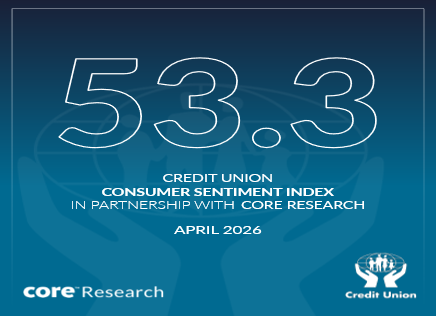
As the table below indicates, the Credit Union Consumer Sentiment Survey (in partnership with Core Research) shows an index reading of 53.3 in April, moderately down on the 56.7 reading for March, and the April 2025 reading of 58.7.

Reflecting the pronounced weakness in Irish consumer sentiment of late, the drop in April was sufficient to leave Irish consumer confidence at its lowest level since December 2022. It is also well below the long-term survey average of 83.3.
So, Irish consumer sentiment is clearly weak at present but not as depressed as some commentary might suggest. Whereas the sharp fall in sentiment in March suggested a marked downgrade of economic and financial prospects by Irish consumers, the April reading doesn’t imply any further dramatic worsening in thinking of late. Instead, it seems to signal that serious concerns that emerged in March have been confirmed by developments in the interim.
In that regard, it should be noted that the cumulative fall in Irish consumer sentiment since February is smaller than seen a year ago as much-increased US tariffs were announced, or in the couple of months following the Russian invasion of Ukraine in 2022 and altogether less dramatic than seen in early 2020 when Covid-19 emerged.
While lower than a year ago, the April 2026 sentiment reading of 53.3 is still some distance above the Covid-19 low-point of 42.6 (April 2020) or the Cost-of-living surge trough of 42.1 (September 2022). So, while the current survey reading suggests Irish consumers are bracing themselves for tougher times ahead, they are not in total despair about the financial conditions they face at present.
If the April sentiment survey doesn't indicate any profound weakening in Irish consumers circumstances, it does highlight vulnerabilities in this regard. The survey suggests that the resilience of Irish consumers has been severely challenged by the cumulative impact of a sequence of shocks to the economic outlook and their financial circumstances. A further surge in living costs might prove one strain too far for significant numbers of consumers, prompting further marked weakening in sentiment and spending.
Energy costs undermining confidence
As diagram 1 below illustrates, recent years have seen a strongly negative relationship between Irish consumer sentiment and Irish energy costs.
Over the past five years, there has been a negative correlation of -0.759 between the monthly sentiment index and the energy component of the consumer price index for Ireland. (The correlation coefficient runs between +1 and -1. So, a reading of -0.759 implies a strong negative relationship. For this calculation, we assumed the change in energy costs between March and April 2026 will be in line with the change in the EU commission’s weekly energy price data for Ireland).

Viewed from this perspective, the drop in Irish consumer sentiment through March and April appears reasonably moderate. The calming influence of the ceasefire in the middle east on global energy prices coupled with the Irish Government’s two tranches of support measures could be playing a role in this regard.
Sentiment slumps in the US, Euro Area and UK in April
A comparison with the most recent consumer confidence trends elsewhere suggests that while Irish consumers are clearly and understandably negative, they are neither uniquely challenged nor entirely fatalistic in their thinking at present.
In contrast to a relatively modest decline in Irish consumer sentiment in April, large falls in consumer sentiment in the US, the Euro area and the UK matched or exceeded the falls seen in March.
The ceasefire in the middle east caused the final estimate for April of US consumer sentiment to recover slightly from the preliminary figure but the survey still reported a drop to its lowest level in fifty years in April. Moreover, the final monthly decline was slightly larger than that seen in March.
The authors of the US report noted a widespread fall in confidence related to the impact of the war in Iran on the US economy. Respondents to the survey mentioned higher prices and weaker asset values, the latter a product of the market-centred nature of US households’ asset holdings, which tend to amplify volatility relative to deposit-focussed savings in Ireland.
The EU Commission noted that Euro Area consumer confidence ‘continued its freefall since the start of the Iran war’, with the monthly decline in April matching that seen in March and consumer confidence in the single currency area dropping to its lowest level since December 2022.
UK consumer confidence also weakened more in April than in March, with GFK, the report authors, noting that confidence now ‘is deteriorating sharply’. Perhaps surprisingly, the largest decline was in relation to the outlook for the UK economy but there were also significant declines in thinking on house finances.
Higher energy costs are clearly undermining consumer sentiment and spending power around the globe at present. In this context, US Energy Information Administration weekly data show retail gasoline prices increased from $3.033 to $4.254 per gallon between the second week in February and the second week in April, a notably larger increase than that seen in Ireland.
In the same vein, EU Commission weekly energy data suggest that between the mid-points of the February and April sentiment surveys, average retail prices for petrol and diesel across the Euro area rose faster and reached a higher level than was the case in Ireland. However, the rise in home heating oil was somewhat larger here.
Finally, In the same vein, RAC data show a faster increase in UK motor fuel prices between February and April than that seen in Ireland. Arguably, sharper fuel rises elsewhere have contributed to somewhat greater weakness in other countries' sentiment measures than in Ireland of late.
The broader point, as diagram 2 illustrates, is that the global energy shock is prompting a sharp and shared nervousness among consumers on both sides of the Atlantic.

Job fears increase markedly in April as cost concerns continue to build
As was the case in March, all five key elements of the Credit Union Consumer Sentiment Survey (in partnership with Core Research) posted month-on-month declines in April.
In the case of four elements, the fall was smaller than that seen in March, the exception being consumers assessment of how their own financial circumstances had evolved over the past twelve months. The monthly decline in April also varied somewhat across the five components of the survey.
After a relatively sharp fall in March, consumer thinking on the economic outlook weakened comparatively little in April. Through the survey period, new forecasts from the Central Bank and ESRI (as well as the IMF’s world economic outlook towards the end of the survey period) did emphasise significant downside risks to the economic outlook for Ireland as well as the extreme uncertainty now prevailing but also highlighted underlying strengths in this economy and didn’t suggest any catastrophic collapse was at hand.
While the weakening in views on the outlook for jobs was smaller than that reported in March, it was larger than that seen in any of the other survey elements in April. Admittedly, there was a slight uptick in the latest unemployment rate to 4.7% (for March) from 4.6% previously. The survey period saw small and largely offsetting announcements of job losses and new jobs.
The relatively weak jobs element of the survey may owe something to significant media coverage of ESRI/Dept of Finance research that suggested that some 7% of employment in the Irish economy could be displaced by AI in the short to medium term. This threat to as many as 200k relatively highly paid jobs suggested that structural changes could weigh on the Irish jobs market even more heavily than the energy shock. This would likely have weighed on consumer thinking on employment prospects in April.
Household finances remain under pressure from higher energy costs
All three elements of the survey that relate to household finances were weaker in April than in March and showed fairly similar declines between the two months.
A somewhat larger decline in April than in March in consumers’ assessments of how their household finances had evolved over the past twelve months likely owed much to the significant recent energy-centred rise in inflation.
While the latest official data showed food price inflation slowed further in March (to 2.3% y/y from 3.3% previously), energy costs increased 12.3% y/y from a flat reading in February. As a result, Irish inflation increased from 2.7% to 3.6%, the largest monthly jump in more than three years (since February 2023).
As we noted a month ago, the latest jump in living costs comes on top of a period of falling living standards of late. Indeed, revised sectoral accounts data (that were released during the survey period but received little attention) suggest the drop was larger than initially indicated.
The average Irish consumer’s disposable income is now estimated to have been 2.4% lower in the final quarter of 2025 than a year earlier. Sharply contrasting fiscal measures over the past two Budgets mean that decline might have become even larger in the first three months of 2026.
Not surprisingly, given the evolving energy crisis, Irish consumers marked down their thinking on the outlook for their household finances more than their experience of the past twelve months in April, repeating the pattern seen in the March survey.
However, the decline in thinking on future financial conditions was notably smaller than that seen in March. Some pull-back in global energy costs on a ceasefire in the middle east, coupled with the announcement of two tranches of energy cost support measures by the Irish Government in late March and just before the April survey finished likely limited but did not reverse the weakness in Irish consumer thinking on the outlook for their personal finances.
Not surprisingly, an unstable global environment and increased pressure on living costs caused consumers to signal a further weakening in spending plans in April. However, after a very large correction in March, the drop in this element of the survey was comparatively modest in April.
Section II; What will Irish consumers do if energy prices remain high?
As usual, the April reading of the Credit Union Consumer Sentiment Survey (in partnership with Core Research) contained a number of special questions intended to shed light on current consumer thinking on topics of specific interest.
This month, we asked consumers what impact higher energy prices would have on their behaviour if they remained in place throughout 2026.
Higher energy costs will hurt!
First of all, we asked consumers how much impact higher energy costs would have on their household finances. The responses, shown in diagram 3 below, suggest, not surprisingly, that higher energy prices will translate into a broadly- based hit to spending power.

Some 54% of consumers say that higher energy prices would have a significant impact on their household finances.
Not surprisingly, consumers already having difficulty making ends meet were about 2 ½ times more likely to give this response than those saying they were managing without difficulty-although roughly three in ten of the latter also indicated that higher energy prices would have a significant impact on them.
In the same vein, the share of consumers indicating a significant impact from higher energy costs was negatively correlated with household income but very substantial numbers of consumers in higher income segments reported that higher energy costs would exert a significant impact on them.
We have commented previously on a tendency in much economic commentary to assume a one for one relationship between higher incomes and greater ‘non-committed’ spending power which is often accompanied by a related tendency to suggest those most vulnerable to an economic shock can be easily identified.
However, life cycle and other significant differences in financial circumstances and commitments suggest the likelihood of marked variations in ‘fixed’ household costs such as those related to housing, transport costs, childcare and education.
In turn, this means that current household income may be a poor barometer of current financial resilience. As a result, this could mean ‘targeted’ support measures might miss significant swathes of households substantially affected by higher energy costs (and misallocate support to others).
Will energy usage change?
The April sentiment survey also asked consumers what impact higher energy prices would have on their energy usage. The responses shown in diagram 4 below suggest significant variations in consumer behaviour.

Survey responses suggest it might be difficult for Irish consumers to markedly or quickly reduce their energy usage in response to higher energy costs.
Just one in three consumers (32%) say they would reduce their energy usage a lot. This response was slightly more common among consumers outside Dublin, and among females than among males. Those struggling to make ends meet were twice as likely to give this response as others. While those in the lowest income segments were somewhat more likely to give this response, there was no marked variation related to income, or by age.
A notable one in five consumers (19%) say they would not be able to alter their energy use. While there were no dramatic demographic differences in these responses, at the margin, this response was more common among those aged under 45 than those aged over 45, perhaps reflecting more fixed transport and other domestic energy use requirements. This response wasn’t more common among those with financial difficulties nor did it correlate with income.
The very small number, some 4%, of consumers indicating no difficulty paying higher energy prices mean demographic differences are not statistically robust for this group but this response was more frequently seen in responses from Dublin consumers and those on higher incomes.
Will higher energy costs cause cutbacks in other areas?
Finally, we asked consumers if higher energy prices would impact their outlays in other areas of household spending. Responses shown in diagram 5 below suggest a fairly significant negative hit to consumer spending generally from higher energy prices, perhaps reflecting difficulties in reducing energy usage in the short term.

Nine in ten Irish consumers (88%) say they would need to cut back spending in other areas if energy prices remain elevated. Two in five of these (some 37% of consumers overall) say they would need to make substantial cutbacks to other areas of spending.
These responses would tend to support our previous contention that the cumulative impact of a range of recent economic ’shocks’ may have left many households altogether less financially robust than aggregate economic and financial measures might imply.
Within the segment of consumers indicating a need for substantial spending cutbacks, demographic differences were not dramatic but there were somewhat fewer consumers from Dublin than elsewhere, more females than males and relatively large numbers of consumers aged between 25 and 34.
Not surprisingly, those facing difficulty making ends meet at present were more than three times as likely to say they would need to make substantial spending cutbacks than others. Those in lower income households were more likely to indicate a need for cutbacks than others but there wasn’t a consistent decline in this response as income increased.
Summary and conclusions
In summary, responses to the set of questions on the prospective impact of higher energy costs on Irish consumers emphasise the significance of financial difficulties and suggest that the spillover impacts of the global energy shock on the Irish economy may be somewhat more pronounced than most recent forecasts currently envisage.
Admittedly, most mainstream forecasts use futures market pricing that anticipates some easing in energy costs as the year progresses whereas consumer sentiment may encompass some risk premium on top of current energy costs.
With increased uncertainty and AI-related constraints likely to curb employment growth materially, ‘real’ incomes currently lower than a year ago and buying power set to come under increased pressure from higher energy costs, particularly for heating later in the year, household spending power is likely to remain muted at best in 2026.
How widespread the potential for a drawdown of household savings to ‘smooth’ consumption growth is far from clear, particularly if Irish consumers expect an extended period of elevated energy costs.
In these circumstances, widely predicted growth in overall household spending of 2% or more in 2026 might require both the early anticipation and arrival of substantial and broad-reaching fiscal support for Irish consumers in Budget 2027.
The Credit Union Irish Consumer Sentiment Survey is a monthly survey of a nationally representative sample of 1,000 adults. Since May 2019, Core Research have undertaken the survey administration and data collection for the Survey. This month’s survey was live between the 1st and the 15th of April 2026.