Modest Improvement in Consumer Sentiment suggests relief at slight Easing in Energy Costs
Posted on: 22 May 2026
-
Irish Consumer confidence recovers but remains weak
-
Broadly based uptick reverses half of recent drop
-
Consumers a little less negative about household finances
Special question focusses on consumers capacity to handle a financial emergency costing €1,000
-
Responses suggest persistence of three-tier structure in Irish household finances; the comfortable, the coping and those clinging on
-
Just over half of Irish consumers would use savings or income to handle an unexpected bill
-
One in four could not cope, would have to sell something or borrow from a lender other than a bank or credit union
Speaking on the release of the May sentiment data and analysis, David Malone, CEO of the Irish League of Credit Unions noted; “The special question in the May Credit Union Consumer Sentiment Survey highlights how challenging the financial circumstances facing Irish consumers are at present. Credit unions are uniquely positioned in the community to support members through all the financial challenges and opportunities they face in these exceptional times".
Summary
Irish consumer sentiment improved in May but continues to point towards a consumer facing significant cost-of-living challenges as well as elevated economic uncertainty.
The improvement in sentiment in May appears to reflect two distinct developments through the survey period. A ceasefire in the middle east seemed to reduce the risk of extremely negative outcomes and prompted some slight easing in global energy prices. At the same time, domestic factors in the shape of Irish Government energy support measures, budget data and official commentary which suggested some scope to partly cushion the blow to the Irish economy from higher global energy costs.
The contrast between the improving if still anxious mood of Irish consumers and a further small decline in US consumer sentiment, that translated into a new 50 year low for that survey, suggests specific Irish developments may have contributed to the increase in Irish consumer confidence in May.
The May sentiment survey still points to a nervous Irish consumer who sees Irish economic conditions and their own household finances now set on a weakening path. However, the slight uptick this month suggests that this deterioration may be less devastating than previously feared.
Section I; Sentiment survey improves but remains subdued in May
As the table below indicates, the Credit Union Consumer Sentiment Survey (in partnership with Core Research) shows an index reading of 59.4 in May, reversing a little over half the cumulative drop recorded over the previous two months which saw the index tumble to 53.3 in April from 65.2 in February.
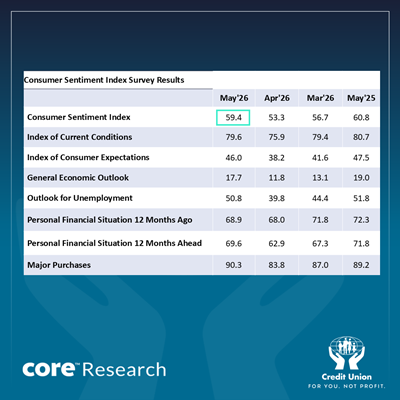
The improvement in sentiment from the forty-month low seen in the April survey still leaves Irish consumer confidence well below the long-term survey average of 83.3, emphasising the broadly negative tone in sentiment at present.
However, the May 2026 reading of 59.4 is broadly similar to the 60.6 average reading for the twelve-month period from May 2025 to April 2026, suggesting that the difficulties facing Irish consumers at present are not altogether more severe now than those they have faced for some time.
US consumer sentiment continues to slide
In contrast to the improvement in Irish consumer confidence in May, US consumer sentiment continued to fall, albeit marginally to reach a new fifty-year low for the survey.
The survey authors noted concerns around rising prices and declining buying power. In this context, it should be noted that motor fuel prices continued to increase in the US between the April and May survey periods whereas Irish motor fuel prices declined. The latest official releases also showed US inflation rose faster and further between April and May in the US (from 3.3% to 3.8%) than in Ireland (from 3.6% to 3.7%).
Broadly based gains suggest a small sense of relief
Refecting the pervasive influence of dramatically changing geopolitical developments of late, all five elements of the sentiment survey showed month-on-month gains in May just as all five had shown declines in both March and April (all five survey elements only moved in the same direction in just three out of twelve months in 2025, in each instance reflecting significant US tariff-related developments).
The upgrade to consumer thinking on the broad economic outlook was smaller than that seen in most other elements of the survey in May. In part, this may have reflected a relatively small decline in this element in April. Most recent commentaries and forecasts have suggested that while there will be a material negative impact to Irish economic activity from higher energy costs, it should prove broadly manageable.
The Dept of Finance’s Annual Progress Report (APR) 2026, published just before the May survey went into the field, largely confirmed other recent forecasts in suggesting activity would remain on a positive trajectory, albeit with a significant slowing in the pace of growth.
Arguably, of greater significance, the APR highlighted a notably stronger trend in the public finances than most recent commentary had suggested. In turn, this suggested notably greater fiscal scope to provide some offset to the adverse impact of higher energy costs on Irish businesses and households.
Other ‘macro’ releases including a sharp increase in new homebuilding in the first quarter of 2026 compared to a year earlier, solid exchequer returns and a largely unchanged inflation rate may have also contributed to some sense of the Irish economy’s resilience in the face of challenging conditions.
The largest improvement in the survey between April and May came in relation to the jobs market. This was also the element that had shown the largest deterioration between March and April. As such, we think the scale of movement seen in May is to a significant extent a correction rather than a fundamental change in thinking. We would also note that the current reading of this element of the survey suggests that Irish consumers remain very negative on the outlook for jobs.
The survey period saw a slight easing in the unemployment rate and some new job announcements but there were also high-profile concerns around tech sector layoffs. However, it may be that concerns around jobs in the previous survey that may have been related to a high-profile report on prospective AI-related job losses eased somewhat at least in terms of their immediacy.
Household finances slightly less threatening but still under pressure
While the three elements of the survey focussed on household spending power all improved this month, their May readings show greater weakness now compared to either the pre-war in Iran level of February 2026 or that of May 2025 than the two ‘Macro’ elements of the survey. This would seem to highlight the central role of cost-of-living concerns in Irish consumer thinking at present.
The smallest month-on-month improvement in the sentiment survey in May came in relation to consumer thinking on how their personal financial circumstances had changed over the past twelve months.
The latest official inflation data show a rate of 3.7% in April, the highest reading in more than two years and markedly higher than the 2.2% rate seen in April 2025. As a result, the average Irish household’s buying power is likely to be materially lower than that of a year ago. Consequently, consumers overwhelmingly negative assessment of their current household finances is not at all surprising.
Encouragingly, the May sentiment survey saw a clear improvement in consumers assessment of the outlook for their household finances and their buying plans. Admittedly, the current level of these readings signals a still very negative Irish consumer. However, the improvement in May suggests that Irish consumers are down but not entirely out.
The uptick in the outlook for household finances and buying plans may reflect both the Irish Government’s measures taken in April to ease the impact of the rise in energy costs and indications that further significant action would be taken in the Budget later this year to cushion the impact of higher costs on households and businesses.
In this context, the Dept of Finance’s Annual Progress Report, published just before the survey commenced, and various official comments that followed underlined the resilience of Ireland’s public finances and the related scope to undertake support measures to partly offset the damaging impact of higher energy costs on the Irish economy. This likely encouraged expectations of a material if still partial offset to the pressure building on household finances.
Section II; Widely varying capacity to handle an unexpected bill continues to highlight three tier structure of Irish consumers financial circumstances
The May 2026 Credit Union Consumer Sentiment Survey (in partnership with Core Research) contained an additional question focussed on Irish households’ capacity to weather a financial emergency, as we have done for the past six years. This is based on a broadly similar question asked in the regular ‘Report on the Economic Well-Being of U.S. households’ conducted each year by the US Federal Reserve.
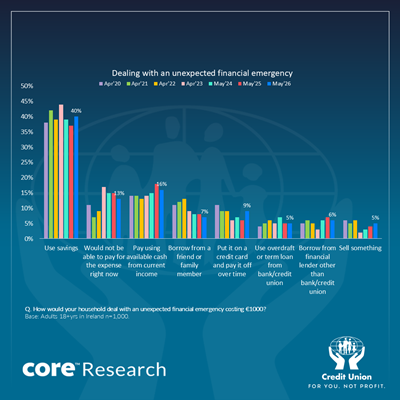
The responses given by Irish consumers to the question ‘How would your household deal with an unexpected financial emergency costing €1000?’ are shown in diagram 1 below for the May 2026 sentiment survey alongside the responses given in previous years.
‘Rainy day’ savings remain the key support
As the diagram indicates, the most common way Irish consumers would handle a financial emergency at present, as has been the case through the previous six years, would be to draw down savings. Two in five Irish consumers (40%) say that they would call on savings in the event of an unexpected financial problem.
In broad terms, the reliance on ‘rainy day’ savings has remained fairly steady through the past six years. At the margin, as the diagram shows, the 2026 results mark a slight break from a downtrend in recourse to savings over the previous two years following a post-Covid peak in early 2023.
It remains the case that, in a more uncertain environment, that significant numbers of Irish consumers attach greater importance to having a material level of precautionary savings. As the overall level of household deposits has continued to increase, these results might also be consistent with a greater concentration of savings in wealthier households of late. Drawing on Central Bank data for Q3 2025, we estimate that the wealthiest 20% of households hold about 60% of Irish households and the average deposit of the top 10% of Irish households is over 14 times as large as the average deposit of the bottom 50% of Irish households. These considerations may need to be considered in regard to the likely efficacy of mooted Government savings support measures.
As might be expected, there was a strong positive correlation between income and capacity to use savings in a financial emergency in the 2026 survey. Over 65’s were far more likely to draw on savings than other age groups, likely reflecting greater accumulated savings as well as less capacity to draw on other sources of financing. Males were also more likely to draw on savings than females.
Higher earners, the young and the old more likely than others to use incomes in an emergency
The 2026 survey results also show a slight pullback increase in those who say they would use their income to handle a financial emergency costing €1000 to around one in six consumers (16%). While changes in this response are marginal, this might reflect renewed cost-of-living strains removing the ‘spare cash capacity’ of some consumers.
Again, as was the case in previous surveys, the share of responses in this category in the 2026 survey trended higher with income, and those making ends meet with ease were again three times as likely to use their incomes to meet a financial emergency as those now facing difficulties in this regard.
Perhaps surprisingly, the age groups most likely to draw on their incomes in a financial emergency were the under 25’s and over 65’s, perhaps reflecting notably greater ongoing and possibly family-focussed financial commitments among consumers in their ‘middle ages’.
Borrowing for an emergency still seen as a minority option
As diagram 1 illustrates, a relatively small number, around one in seven Irish consumers (14%) would use a credit union or bank loan or their credit card to handle a financial emergency costing €1,000.
Those with difficulty making ends meet were two and a half times more likely to borrow than those without problems in this regard. Borrowing was notably more common among those aged under 55 than older age groups and also trended higher as incomes rose but fell back among the highest earning consumers.
Differences in capacity to handle a financial emergency suggests some Irish consumers are comfortable, some are coping and some are just clinging on
It might be suggested that those consumers who would use their savings or income to cope with a financial emergency could be described as ‘comfortable’ in that they have some spare financial capacity to cope with the unexpected. Judged in this light, some 56% or a little over half of Irish consumers might be said to be financially comfortable at present.
At the other end of the spectrum a significant 13% of Irish consumers say they would be unable to cope with a financial emergency costing €1000 in 2026. Not surprisingly, there is a very strong negative correlation between this response and income, while those reporting difficulty making ends meet are nearly seven times more likely to say they couldn’t cope with a financial emergency than those without current problems in this regard.
Females were nearly twice as likely to give this response as males and those aged between 35 and 44 were markedly more likely to give this response than other age groups, possibly reflecting a greater incidence of pre-committed household outlays.
While the 13% share of Irish consumers saying they could not handle an emergency costing €1,000 is lower than the peak 17% share reported in 2023, it still represents a higher share than the 7% of consumers who said they would be unable to handle a financial emergency costing €1000 in the 2021 survey. In that respect, these results suggest continuing strains on household finances in Ireland from the recent cost-of-living crisis.
We might also expect a trend easing in numbers unable to cope as the rise in consumer prices in recent years means the ‘real’ cost to Irish consumers of a financial emergency costing €1,000 in 2026 is materially lower than a €1,000 emergency in earlier years (the inflation adjusted value of a bill for €1,000 today would be a bill for just under €1100 in 2023 and €1250 in 20210).
While there are relatively small numbers of consumers in most other categories of responses, most of these could be deemed to suggest some degree of financial difficulty.
As in the 2025 results, this year’s survey suggests a broadly similar incidence of reliance on financial lenders other than on banks and credit unions. This response was much more common among those facing difficulties making ends meet but didn’t show any clear variation across income ranges. As we noted last year, this may seem to suggest a small but not insignificant group of consumers are both cash and credit-constrained. This might also be true of the small number who say they would resort to selling something to handle a financial emergency.
Overall, the 2026 special question on the ways consumers would cope with a financial emergency once again highlights the persistence of marked variations in the financial circumstances and conditions faced by Irish households.
Drawing together those who can meet an unexpected financial emergency through savings or from their current incomes, the 2026 survey repeats the findings of previous years in that it suggests that a little over half of Irish consumers might be described as ‘comfortable’ at present.
At the other end of the financial spectrum, roughly one in four Irish consumers might be considered to be ‘clinging on’. This grouping includes those who say they could not handle a financial emergency at present as well as those who would resort to borrowing from a lender other than a bank or credit union and those who would sell something. (We would note that these results are broadly consistent with recent ESRI research that indicated ‘over 30% of households experience some form of energy affordability challenge when multiple measures are considered’. (More than one in ten households cannot afford a warm home or their energy bills | ESRI)).
In the middle are another grouping that amounts to about one in five Irish consumers who are ‘coping’ in that they would meet an unexpected financial difficulty by borrowing from family or friends, or from a bank or credit union, or by using a credit card.
There are no dramatic changes to the shares of these three groupings over the past five or six years. At the margin, there is a slight drop in numbers coping, offset by marginal increases in both those who might be described as comfortable and those who are clinging on. This would not be entirely surprising in an economy where overall ‘macro’ performance has been very strong but one that has also endured a marked increase in living cost pressures; although we’ve all been in the same storm, we’re not all in the same boat.
This continuing divergence may play some role in explaining the persistence of strong growth in consumer spending overall (augmented significantly by rising numbers living and working here) alongside an increasingly fractious sense of being ‘left behind’. In that respect it accords with much US commentary on the so-called K-shaped economy in the ‘States.
In that context, recent research by the Federal Reserve Bank of New York (Tracking the K-Shaped Economy: Who’s Driving Spending? - Liberty Street Economics) suggests that ‘retail spending growth has been driven by high-income households—those earning more than $125,000 per year’, and that ‘consumption has exhibited a K-shaped economy since 2023, although not in the pre-COVID period or during the post-COVID recovery’.
Other recent New York Fed research Same Shock, Different Roads? A K-Shaped Pattern at the Pump - Liberty Street Economics also found that ‘with the sharp increases in gasoline prices in March, a K-shaped pattern in gasoline consumption emerged—showing faster consumption growth for high-income households relative to low-income households’.
The varying impact of higher inflation on the financial circumstances of Irish households would likely worsen the divergence experienced in recent years. The case can be made for broad supports reflecting the large and wide-ranging impact of higher energy costs. However, countering the risk of deeper divisions in financial capacity, that may damage economic efficiency as well as equity, emphasises the importance of getting the balance of supports (and other policy adjustments) right in next October’s Budget.
The Credit Union Irish Consumer Sentiment Survey is a monthly survey of a nationally representative sample of 1,000 adults. Since May 2019, Core Research have undertaken the survey administration and data collection for the Survey. This month’s survey was live between the 1st and 7th May 2026